Most safety meetings fail because they’re generic, rushed, or recycled from outdated manuals. Workers zone out. Supervisors check a box. And when an incident occurs, the question isn’t “Did we talk about it?” but “Did anyone actually remember it?”
The solution isn’t more meetings—it’s better ones. And that starts with the right topic.
Free toolbox talk topics are widely available, but few deliver clarity, relevance, or real engagement. This guide cuts through the noise. You’ll get actionable, ready-to-use themes—tailored for construction, manufacturing, facilities, and field services—that spark discussion, reinforce safe habits, and meet compliance needs—without spending a dollar.
Why Most Free Toolbox Talk Topics Fall Short
Not all free resources are created equal. Many downloadable PDFs from obscure sites offer the same tired list: “Hard Hat Safety,” “Fall Protection,” “PPE.” While important, these topics often lack context. They don’t answer:
- What specifically went wrong last week?
- What’s changing on the site this month?
- What near-miss did someone just experience?
A good toolbox talk isn’t a lecture—it’s a conversation. And a great one ties directly to real conditions, recent events, or upcoming risks.
- Too broad – “Electrical Safety” without mentioning arc flash risks on current equipment
- No discussion questions – Just facts, no engagement
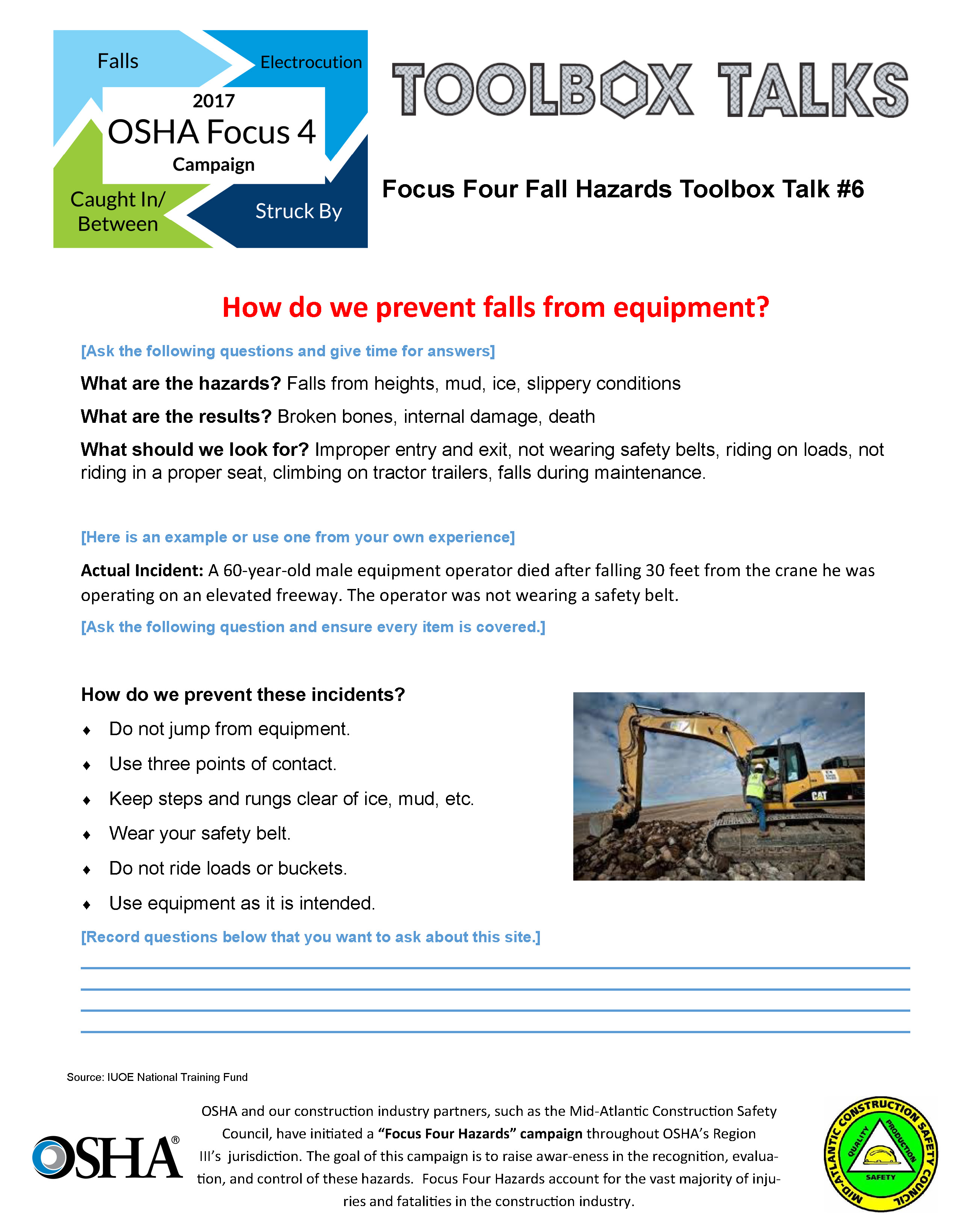
- No visual aids – Hard to follow without diagrams or photos
- Not actionable – Doesn’t end with “Here’s what we will do differently”
Fix this by choosing or adapting free topics to fit your site’s actual work. Use the examples below as templates—not scripts.
10 High-Impact Free Toolbox Talk Topics (With Real Examples)
These topics are field-tested, widely applicable, and structured to encourage participation. Use them as-is or customize with your own site details.
1. Near-Miss Reporting: Why Silence Is Dangerous Use Case:
After a dropped tool narrowly misses a worker. Discussion Starters: - “Has anyone seen something almost go wrong this week?” - “What stops people from reporting near-misses?” Action Step: Assign one person to share a near-miss story. Post a reporting reminder near time clocks.
2. Ladder Safety: It’s Not Just About the Angle Use Case: Frequent ladder use in HVAC or maintenance. Key Points: - Inspect for cracks, loose rungs, or bent side rails - 3-point contact rule - Don’t stand on the top two rungs Visual Tip: Print a ladder inspection checklist and walk through it live.
3. Weather-Related Hazards (Heat, Cold, Wind) Use Case: Summer roofing crews or winter utility line work. Discussion: - “What are our signs of heat stress?” - “Where’s the nearest cool-down area?” Action: Review break schedules and emergency procedures for weather events.

4. Hand Safety: Crush, Cut, and Pinch Points Use Case: Manufacturing lines or mechanical work. Real Example: A worker caught a glove in a conveyor belt. Checklist: - Remove jewelry - Keep hands clear of moving parts - Use push sticks or tools when possible
5. Slips, Trips, and Falls on the Same Level Fact:
These cause more lost-time injuries than height-related falls. Discussion: - “What clutter is building up in our work zones?” - “Are walkways clearly marked?” Action: Do a 2-minute site scan—identify one trip hazard to fix immediately.
6. Proper Use of PPE: Beyond Just Wearing It Problem: Workers wear hard hats backwards or gloves past their life span. Discussion: - “When does PPE become unsafe?” - “What PPE do we think we need but don’t?” Tip: Bring in old gear for inspection—show what damage looks like.
7. Back Safely: Lifting, Carrying, and Team Lifts Use Case: Material handling in construction or warehousing. Myth Busting: - “Lifting belts prevent injury” → Not proven - “Bend the knees” → Also bend at hips, keep load close Demo: Practice lifting a box together—wrong way, then right way.
8. Mobile Equipment Blind Spots Use Case: Forklifts, loaders, or dump trucks on site. Activity: Walk around a vehicle—mark dead zones with tape. Rule: “If you can’t see the operator’s face, assume they can’t see you.”
9. Hot Work and Fire Prevention Use Case: Welding, grinding, or torch use. Checklist: - Fire watch assigned? - Flammables moved? - Extinguisher on-site and charged? Story: Share a real fire incident from industry news.
10. Mental Fatigue and Focus on the Job Underreported Risk: Tired workers make more errors. Discussion: - “What makes your focus drop during a shift?” - “How can teammates notice when someone’s struggling?” Action: Normalize speaking up about fatigue—no blame.
How to Run a Toolbox Talk That Sticks
A great topic fails if the delivery is weak. Follow this 5-step workflow:
- Pick a Relevant Topic – Tie it to current work, a recent incident, or seasonal risk.
- Prepare in Advance – Print a one-page handout, bring a photo, or set up a demo.
- Start with a Question – “How many of you have seen this before?”
- Keep It Under 10 Minutes – Focus on one key behavior.
- End with an Action – “Today, we’ll all check our ladders before use.”
Pro Tip: Rotate facilitators. When workers lead, engagement soars.
Where to Find Reliable Free Toolbox Talk Resources
Many sites offer free downloads—but quality varies. Stick to sources with industry credibility and clear formatting.

| Resource | Strengths | Limitations |
|---|---|---|
| OSHA.gov | Authoritative, compliant, printable | Less conversational |
| CPWR (Center for Construction Research) | Construction-specific, research-backed | Slightly technical |
| HSE UK (hse.gov.uk) | Practical, visual, well-structured | Uses British terms (e.g., “hard hat” = “safety helmet”) |
| SafetyInfo.com | Large library, easy to scan | Some content feels dated |
| NASP (National Association of Safety Professionals) | Professional templates | Mix of free and gated content |
Always review and localize content. Change examples, add site photos, and insert your company’s rules.
Customizing Free Topics for Your Team
Don’t just hand out a PDF. Make it yours.
Example: You download a free “Fall Protection” talk. Improve it by: - Adding a photo of your roof access point - Naming the harness model your team uses - Mentioning the last inspection date of anchor points - Asking: “What’s one thing that could fail on our setup?”
This turns generic advice into shared ownership.
Common Mistakes to Avoid
Even with great topics, pitfalls sink effectiveness:
- Reading verbatim – Workers disengage. Use bullet points, not paragraphs.
- Holding talks in bad locations – Wind, noise, or cold kills focus. Find shelter.
- No follow-up – Did behavior change? Check in next week.
- Only addressing new hires – Refreshers for veterans prevent complacency.
- Skipping documentation – Sign-in sheets prove compliance during audits.
“A toolbox talk isn’t complete until someone signs the sheet and acts on it.”
Final Thoughts: Make Safety a Conversation, Not a Chore
Free toolbox talk topics are abundant—but their value depends on how you use them. The best meetings aren’t the most polished. They’re the most honest.
Pick a topic that matters today. Talk like a human, not a safety robot. Ask real questions. Listen more than you speak.
Then, do it again tomorrow. Consistency beats perfection.
Start with one of the ten topics above. Customize it. Deliver it with confidence. And turn your next 10-minute huddle into a moment that actually prevents harm.
FAQ
Where can I get free toolbox talk topics? Reliable sources include OSHA.gov, CPWR, HSE UK, and SafetyInfo.com. Always verify relevance to your industry.
How long should a toolbox talk last? Aim for 5–10 minutes. Focus on one clear topic and actionable takeaway.
Do toolbox talks need to be documented? Yes. Keep sign-in sheets with names, date, topic, and facilitator for compliance and audits.
Can workers lead toolbox talks? Absolutely. Rotating facilitators builds ownership and improves engagement.
How often should toolbox talks happen? Weekly is ideal. Daily for high-risk tasks or after incidents.
What makes a toolbox talk effective? Relevance, interaction, brevity, and a clear call to action.
Should I use visuals? Yes. Photos, diagrams, or real equipment make abstract risks tangible.
FAQ
What should you look for in Free Toolbox Talk Topics for Safer Workplaces? Focus on relevance, practical value, and how well the solution matches real user intent.
Is Free Toolbox Talk Topics for Safer Workplaces suitable for beginners? That depends on the workflow, but a clear step-by-step approach usually makes it easier to start.
How do you compare options around Free Toolbox Talk Topics for Safer Workplaces? Compare features, trust signals, limitations, pricing, and ease of implementation.
What mistakes should you avoid? Avoid generic choices, weak validation, and decisions based only on marketing claims.
What is the next best step? Shortlist the most relevant options, validate them quickly, and refine from real-world results.